
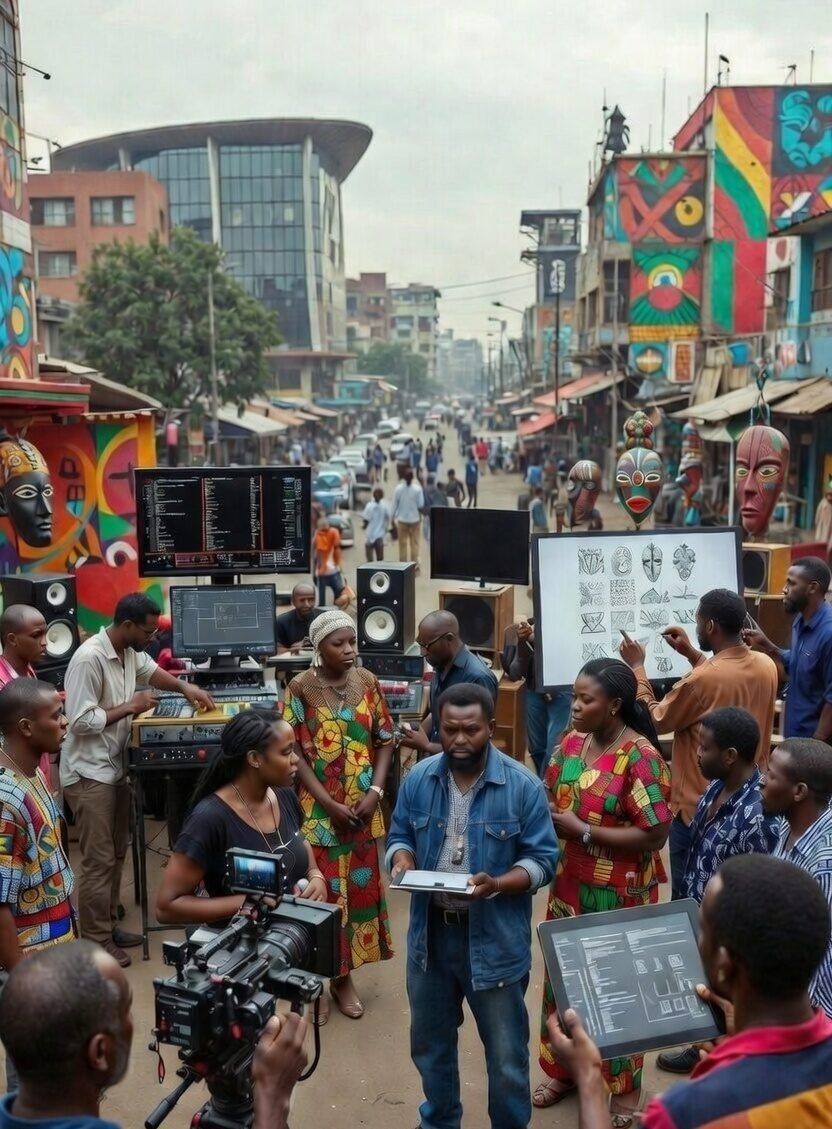
Across Africa, crowds cheer as local films break box-office records, Afrobeat music excites the world, and designers from Lagos to Cape Town shine on global runways. But behind these big successes, a quiet change is happening. Generative AI is reshaping Africa’s film, music, and fashion scenes. Now, creators can bring their ideas to life faster and more cheaply. They no longer face the same high costs, long waits, or lack of resources.
For independent filmmakers with small budgets, producers working from home, or designers staying up late, generative AI is creating new opportunities. It helps creators quickly try out visuals, music, scripts, or design ideas. This lowers barriers and encourages bolder work. AI does not replace human creativity. Instead, it gives more people the chance to share their stories, sounds, and styles with the world.
In this post, we look at how generative AI is changing Africa’s film, music, and fashion industries in 2026. We will also share simple steps and tips for creators who want to get started with these tools. You will see what is possible and find helpful resources for your own creative journey.
Why Generative AI Matters So Much
Africa’s creative industries are already big parts of the economy. Nollywood makes thousands of films each year. Afrobeats shapes global pop music. African fashion is featured at events like Lagos Fashion Week. But for many new artists, the journey has been hard. Expensive gear, low funding, and slow production often stop good ideas from becoming reality.
Generative AI is changing this. Text-to-video tools turn words into movie scenes. AI music programs create beats and melodies fast. Design platforms make many versions of prints or clothes in seconds. Now, creators can test ideas quickly, waste less, and spend more time on storytelling and culture.
For beginners, easy and affordable AI tools are making it simpler to get started. Platforms like Canva AI, LALAL.AI for splitting audio, Adobe Firefly for making images, and ChatGPT or Gemini for writing scripts all offer free or trial versions. RunwayML lets you create videos from text with a basic plan. These tools are simple to use and work on a browser or smartphone, so more new creators can try them.
Generative AI in Nollywood and African Film
Nollywood has long been one of the world’s most prolific film industries, but constraints like budget and time have limited its scope. Generative AI is helping creators push their boundaries even further.
In April 2025, Makemation came out as Africa’s first major AI movie. It was produced by Toyosi Akerele-Ogunsiji and directed by Michael Akinrogunde. The film tells the story of a smart girl from a rural area who uses technology to solve problems. It mixes real-life scenes with AI-made visuals. Tools like Google’s Veo and OpenAI’s Sora helped create the film’s pictures, script, and translated the film in different languages. Makemation made ₦32 million in its first four days and started big talks about how AI is changing storytelling.
Senegalese filmmaker Ousmane William Mbaye used AI to make a powerful music video about the 1944 Thiaroye massacre. The video mixed true history with strong emotions and got almost 2 million views on YouTube. It showed that AI can help tell important stories from the past without needing a big crew.
Tools like RunwayML, Pika Labs, and Adobe Firefly now help small film teams make backgrounds, concept art, and try out different scenes without needing big design crews. For example, a movie producer in Lagos can test three different looks for a scene in one afternoon. Before AI, this could take a week and cost a lot more.
AI also helps after filming is done. Tools like ElevenLabs and Deepdub can quickly add subtitles and dub films into other languages. This is important in Africa, where people speak over 2,000 languages. Now, a movie in Yoruba can be easily dubbed into Swahili or Zulu for much less money than before.
Generative AI in Afrobeats and African Music
Generative AI opens new possibilities. Platforms generate rhythms, melodies, or full tracks based on descriptions. Nigerian artist Ayo Jay experimented with AI to fuse traditional African rhythms into contemporary sounds. Such tools help revive older genres or amplify Afrobeats and Amapiano globally.
Producers now use tools like Suno AI, Udio, or Soundverse to make beats, melodies, or music parts in seconds. These tools help mix traditional sounds, like log drums and congas, with modern music styles. In 2026, many songs made with AI have gone viral. Creators use royalty-free music sounds to create fascinating tracks.
AI can also create cover songs and voices that sound full of emotion, like Afro Soul versions. These AI-made tracks have gotten millions of streams, showing how the technology helps music reach more people. The African music market grows steadily. Streaming platforms expand reach. AI supports this by enabling faster prototyping and personalization. A producer can now test multiple variations in hours instead of days.
Concerns about originality persist. Many worry AI might dilute human artistry or raise ownership questions. Responsible creators treat these tools as collaborators. They input cultural references and refine outputs. This preserves voice while expanding possibilities.
Generative AI in African Fashion
African fashion is getting worldwide attention. Designers from Lagos, Accra, and Nairobi dress international stars and are featured in magazines like Vogue. The big challenge has been growing from one-of-a-kind outfits to larger production, while keeping their unique style.
At Africa Fashion Week London in August 2025, the first fashion collection made fully with AI was shown. Meta AI and designer Ifeanyi Nwune (I.N Official) worked together on the Fall/Winter 2025 “Transcendence” line. They used Meta’s AI tools to create ideas, make patterns, test designs virtually, and create visuals. The collection mixed African fabrics like Ankara and Kente with modern, futuristic styles. In Lagos, designers use AI to predict fashion trends, let customers try on clothes virtually, and make images for ads. This helps save materials and lets them create new designs faster.
Tools like Midjourney, Adobe Firefly, and CLO3D allow designers to generate garment concepts, visualize fabric patterns across different silhouettes, and prototype digitally before cutting a single meter of cloth. Furthermore, this reduces waste, speeds up collection development, and makes trend responsiveness faster.
Challenges and the Path Forward
Many businesses in Africa report that data infrastructure, not creativity, is the limiting factor in AI adoption. Reliable internet, computer access, and AI literacy gaps are genuine obstacles. These are not reasons to wait; they are problems to solve in parallel.
Cloud-based generative AI tools have largely lowered the hardware barrier. A designer or filmmaker working from a mid-range laptop in Accra or Kigali can access the same Midjourney or Runway interface as someone in London. What remains is the skills gap, and that is addressable through targeted training.
The second concern is authenticity and originality. African creative identity is a competitive advantage globally. The goal of using generative AI should never be to produce generic output faster. It should be to produce distinctly African output at a scale and speed the market demands.
African creators are leading the response. Through events like Naija AI Film Festival, community networks, and calls for ethical guidelines that prioritize consent, ownership, and respect. The emerging view: treat generative AI as a collaborator that enhances human vision, not a shortcut that replaces it.
Conclusion
Generative AI is reshaping Africa’s film, music, and fashion industries. Creation is now more accessible, experimentation is bolder, and global reach is easier. This shift also sparks important debates about authenticity and ownership. From AI-made movies like Makemation to new Afrobeats songs and bold fashion at big shows, these tools help creators share stories, music, and styles that show Africa’s rich culture.
In 2026, the best work will come from people who mix technology with heart. They use AI to push boundaries but still keep culture and human creativity at the center. Africa’s creative world has always been strong and original, and now AI gives creators even more power to keep moving forward.