
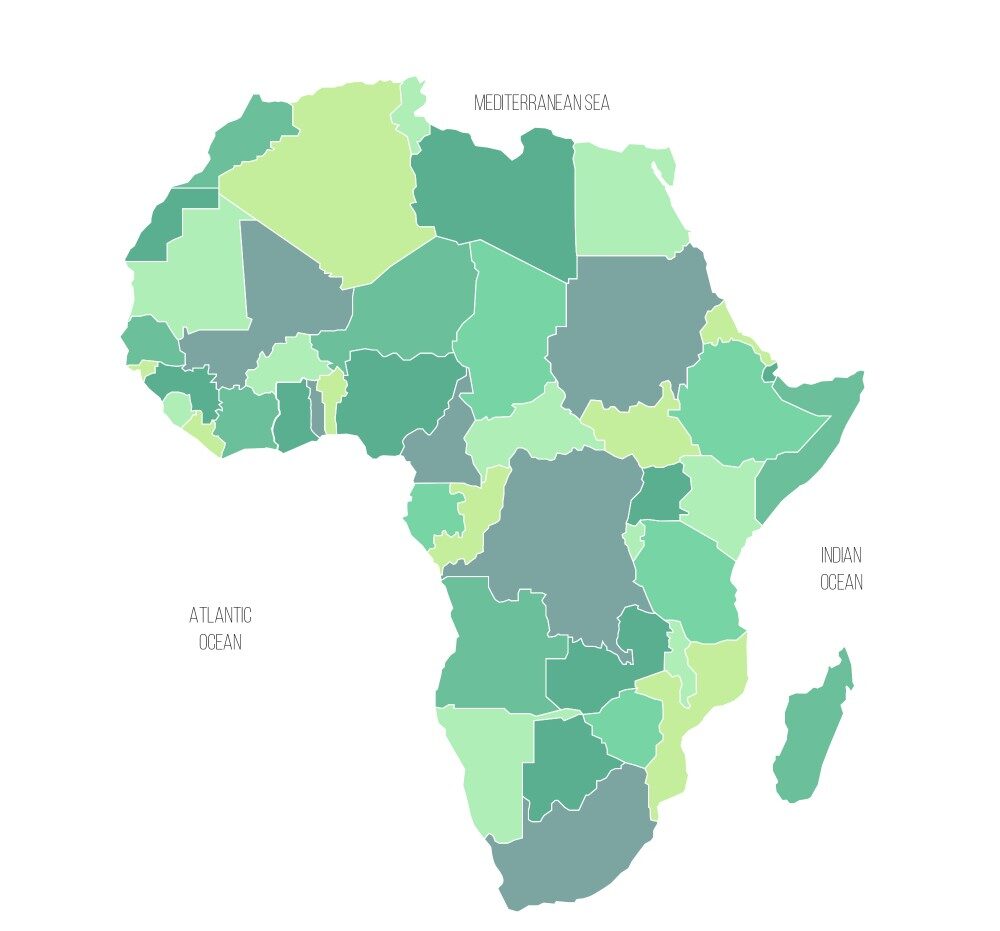
Artificial intelligence (AI) is no longer just a future idea; it is becoming a reality in Africa right now. Even though Africa still has a small share of global AI development, some countries are emerging as AI powerhouses and making big moves. They are investing in new policies, supporting startups, building better infrastructure, and investing in equipping their citizens with digital skills.
The Government AI Readiness Index 2025 by Oxford Insights is the most authoritative recent benchmark. It evaluates the government’s capacity to adopt and govern AI responsibly across six pillars: policy capacity, AI infrastructure, governance, public-sector adoption, development & diffusion, and resilience.
In Africa, Egypt leads decisively as the top-ranked country. In Sub-Saharan Africa, Kenya, South Africa, Mauritius, Nigeria, and Rwanda form a strong cluster of performers. This article focuses on these highest-ranking governments, covering their readiness, key strengths, real-world applications, and contributions to Africa’s AI future.
Here’s a quick overview of the top African performers in the 2025 Government AI Readiness Index (global ranks out of 195):
Country |
Global Rank (2025) |
Government Policies / National AI Strategy |
Startup Ecosystem & Funding |
Infrastructure & Digital Readiness |
Combined Talent & Research Ecosystem |
|---|---|---|---|---|---|
| Egypt | 51st (1st in Africa) | Second National AI Strategy 2025–2030 (6 pillars); perfect policy score | Fast-growing Cairo scene; ~$614M tech + $500M summit deals | Scalable cloud/data; regional NLP edge | Strong Arabic AI research; high talent rankings & expertise |
| Kenya | 65th | National AI Strategy 2025–2030 (3 pillars); launched March 2025 | Vibrant Nairobi/iHub; led funding ~$984M–$1.04B | Mobile money legacy (M-Pesa); improving digital hubs | Growing developer community; strong innovation partnerships |
| South Africa | 67th | National AI Policy Framework; G20 AI Taskforce | Mature ecosystem; ~$599–643M equity leader | Strongest formal infrastructure; advanced banking/cloud | Leads AI Talent Index; top universities & research collaboration |
| Mauritius | 71st | Blueprint 2025–2029; ethical AI & public-service focus | Growing digital inclusion ecosystem; stable funding | Excellent digital infrastructure & connectivity | Strong workforce readiness & skills development |
| Nigeria | 72nd | NAIS revised Sept 2025; AI Scaling Hub | Lagos hub; 120+ AI startups; $1.2B cumulative | Fintech-built data systems; improving broadband | Largest developer community; strong fintech innovation base |
| Rwanda | 75th | National AI Policy (4 pillars); strong execution | Innovation hubs & partnerships; international funding | Strong digital public infrastructure & data-sharing | Widespread skills programs; growing innovation focus |
What Makes Africa’s AI Powerhouses Unique
The term “AI powerhouse” is not about size alone. Top-ranking African countries stand out through strong government commitment (national AI strategies, governance frameworks), investments in infrastructure and skills, and real-world public-sector adoption.
The Indicators That Matter
Key indicators include:
- National AI strategies or digital economy policies
- Government investment in AI infrastructure and talent development
- Public sector experimentation and ethical frameworks
- Private ecosystem support (startups and business adoption)
- Combined talent and research ecosystem (developer community, skills programs, university output, and innovation networks)
1. Government Policies / National AI Strategies
Government policies form the bedrock of AI readiness by establishing direction, ethical boundaries, and incentives for widespread adoption. Egypt currently holds the strongest position in Africa with its comprehensive second National AI Strategy (2025–2030), launched in January 2025. This strategy is built around six well-defined pillars: governance, technology, data, infrastructure, ecosystem, and talent. It also includes ambitious national targets such as contributing 7.7% of GDP from ICT by 2030 and training 30,000 AI specialists. The clarity and ambition of this framework have already delivered tangible results, including $500 million in new investments announced at the AI Everything MEA summit in February 2026.
Kenya has adopted an equally forward-looking approach with its National AI Strategy 2025–2030, released in March 2025. Focused on three strategic pillars: digital infrastructure, data ecosystems, and research & innovation, the strategy positions Kenya as a leading hub for localized AI model development while emphasizing sustainable development and social inclusion. It is reinforced by complementary initiatives, such as the AI 10 billion program (in partnership with UNDP and AfDB), which aims to create 40 million jobs by 2035.
South Africa has taken a deliberate, progressive path with its National AI Policy Framework (2024/2025), which serves as a stepping stone toward a comprehensive national strategy. This framework includes participation in the G20 AI Taskforce and the launch of the AI for Africa Initiative to promote continental cooperation. A 2025 public attitudes survey revealed that 68% of South Africans hold positive views of AI but expressed a clear demand for stronger governance mechanisms.
Mauritius pursues a practical and governance-centered model through the “Blueprint for Mauritius – A Bridge to the Future” (2025–2029). This policy integrates ethical AI principles and widespread public-service applications while aligning closely with international best practices, positioning Mauritius as a secure and innovative digital hub despite its smaller scale.
Nigeria has demonstrated impressive recent momentum with its National Artificial Intelligence Strategy (NAIS), revised in September 2025, and the launch of the AI Scaling Hub. The country performs particularly well in the Policy Capacity pillar (35th globally) and centers its approach on responsible AI, job creation, and social inclusion.
Rwanda places strong emphasis on execution with its National Artificial Intelligence Policy, structured around four pillars: skills development, infrastructure, governance, and collaboration, and has successfully attracted international partners through disciplined planning and implementation.
Egypt and Kenya currently set the standard for depth and ambition in national strategies, while South Africa and Rwanda stand out for effective execution and regional collaboration. Mauritius and Nigeria show strong recent progress but are still maturing compared to the current leaders.
2. Startup Ecosystem Maturity
Startup ecosystems play a central role in translating AI ambition into practical, scalable solutions that address local challenges. Egypt’s Cairo ecosystem has experienced rapid expansion, growing by 25% in 2025, with a clear concentration on health tech (AI-driven diagnostics in low-resource settings), edtech (personalized learning platforms), and business software. This momentum is supported by more than 250 startups operating in alignment with the national strategy.
Kenya’s Nairobi ecosystem, anchored by established hubs like iHub, continues to excel at applying AI to pressing real-world needs in farming (crop monitoring and yield prediction), healthcare (telemedicine and diagnostics), and education (adaptive learning tools), building directly on the country’s foundational mobile money success with M-Pesa.
South Africa’s ecosystem stands as the most mature on the continent, characterized by high-value equity deals in fintech, insurtech, and enterprise AI solutions, along with widespread private-sector adoption across multiple industries.
Mauritius is steadily developing a focused digital inclusion ecosystem that prioritizes secure technology services and serves as a practical model for smaller African nations seeking to advance without relying on large-scale resources.
Nigeria’s Lagos ecosystem remains the continent’s largest tech investment hub, home to over 120 AI-focused startups led by fintech leaders such as Flutterwave and Paystack. These companies are expanding AI applications into health tech (for example, Ubenwa Health for infant diagnostics) and agri-tech (CropSense AI for yield optimization).
Rwanda’s ecosystem revolves around government-backed innovation hubs and initiatives designed to attract international partnerships and drive service delivery and economic transformation.
Nigeria and Kenya lead in vibrant, challenge-solving startup activity, while Egypt demonstrates the fastest recent growth rate. South Africa brings maturity and scale to the table, whereas Mauritius and Rwanda concentrate on niche, policy-aligned ecosystems that reinforce their government-led strategies.
3. Access to Funding
Funding serves as the critical fuel that allows startups to scale and infrastructure investments to materialize. Kenya led the continent in total funding during 2025, attracting between $984 million and $1.04 billion. Much of it driven by large debt deals and megaprojects that directly support agri-tech and health innovation.
South Africa reclaimed its position as the leader in equity funding, securing approximately $599–643 million in 2025 while recording the highest number of equity deals and maintaining a balanced mix of debt and equity financing.
Egypt drew roughly $614 million in broader tech funding during 2025, with a substantial boost from $500 million in commitments announced at the AI Everything MEA summit in February 2026.
Nigeria recorded around $343 million in broader tech funding in 2025 (during an ongoing recovery phase), supported by a cumulative $1.2 billion in tech investments across its ecosystem of more than 120 AI startups.
Mauritius sustains stable funding inflows through strong international alignment and consistent investor confidence.
Rwanda continues to attract consistent international funding thanks to clear policy execution and reliable partnerships.
Kenya and South Africa currently top the continent in overall funding volumes, while Egypt exhibits the strongest recent momentum. Nigeria maintains an impressive cumulative investment base, whereas Mauritius and Rwanda prioritize high-quality, policy-supported inflows over sheer volume.
4. Infrastructure & Digital Readiness
Infrastructure determines whether AI technologies can be deployed effectively at scale, encompassing data systems, connectivity, and compute power. South Africa possesses the strongest formal infrastructure on the continent. It features advanced banking and cloud systems, excellent connectivity, and reliable compute resources that support both research and enterprise applications.
Mauritius exemplifies effective digital infrastructure and connectivity for smaller nations, achieving high readiness despite its size. Egypt focuses on scalable cloud infrastructure and data availability, leveraging its strengths in Arabic natural language processing. Kenya capitalizes on the strong digital foundation from M-Pesa, expanding digital economy hubs and connectivity. Rwanda heavily invests in digital public infrastructure and data-sharing frameworks. Nigeria has robust data systems from fintech leaders and improving broadband access, but it faces challenges in power supply and computing resources.
Overall, South Africa and Mauritius excel in infrastructure readiness, while Egypt and Rwanda show strong policy-driven progress. Kenya and Nigeria rely on sector strengths but still face significant limitations.
5. Talents & Research Ecosystem
Talents are crucial for advancing AI in Africa. South Africa tops the African AI Talent Index, with top universities providing strong data science and AI training. Nigeria has the largest developer community on the continent, boasting over 200,000 skilled professionals in fintech and applied innovation. Egypt emphasizes specialized Arabic AI expertise to cater to regional needs. Kenya has a growing talent pool focused on practical skills and international collaboration for rapid innovation. Mauritius aims for workforce readiness and skills development to cultivate a digitally capable population. Rwanda promotes inclusivity in the AI economy through initiatives like the Digital Ambassador Program.
Overall, South Africa and Nigeria excel in scale and depth, while Egypt, Kenya, Mauritius, and Rwanda emphasize practical training and capacity building for future growth.
When it comes to research, South Africa boasts the strongest ecosystem, driven by leading universities and the South African Centre for Artificial Intelligence Research (SACAIR), promoting global collaboration and knowledge exchange. Egypt stands out with its focus on Arabic AI research and regional expertise, backed by high talent rankings. Nigeria leads in scale due to its vast developer base and fintech innovation. Kenya’s ecosystem thrives on active developer communities and partnerships like AI4D Africa. Mauritius is dedicated to building digital workforce readiness and long-term skill development for AI adoption. Rwanda is expanding through skills programs and enhanced research collaboration.
While South Africa and Egypt excel in depth and specialization, Nigeria offers unmatched scale, and Kenya, Mauritius, and Rwanda emphasize collaborative growth to strengthen their ecosystems.
6. Additional Ecosystem Factors
Beyond the core metrics, other elements contribute to the strength of these AI ecosystems. GitHub activity remains high in Nigeria and South Africa, reflecting large active developer communities and open-source contributions. Hackathon participation is particularly strong in Kenya and Rwanda, where local events foster rapid innovation and collaboration among emerging talent. University research output continues to be a key driver in South Africa, where institutions produce significant academic work, and in Egypt, where research is increasingly focused on Arabic language models and regional applications.
These factors, while not the primary yardstick, support the broader ecosystem and help sustain long-term AI momentum in the leading countries.
What the Rest of Africa Can Learn — and Do Right Now
The gap between Africa’s leading AI nations and the rest of the continent is real, but it is not fixed. Ghana, Morocco, Senegal, and Ethiopia are all working to grow their tech industries, with clear support from their governments and more activity from private businesses.
Above all, the main lesson from the leading countries is clear: AI ecosystems don’t grow from technology alone. They need clear government policies, investment in talent, strong business interest, and good data systems. When countries work on all four together, they make faster progress.
Conclusion
Africa’s AI powerhouses have established proof points that the rest of the continent can build from. Egypt’s government-led AI plans, South Africa’s strong research, Kenya’s hands-on innovation, Nigeria’s focus on fintech and data, Mauritius’s governance maturity, and Rwanda’s execution strength are not just separate success stories; they show a path forward.
If your business is in Africa and you want to use AI, you can learn a lot from what these leading countries are doing. CipherSense AI works with African businesses to turn these lessons into real strategies. We help you choose the right tools and build the skills you need to use AI effectively in your own company. Get in touch with the CipherSense AI team to explore what AI leadership can look like for your organization.